















A Guide to April’s Solar Eclipse
Above us, an infinite celestial expanse unfurls, a world of wonders we can observe but never truly touch. Its enchantment knows no bounds, captivating seasoned stargazers and casual skyward glancers alike.
After all, who hasn’t at one point sought solace in the tranquil night sky or scanned the stars for a favorite constellation?
On April 8, however, a rare daytime spectacle will grace the skies—a total solar eclipse. Another one won’t cross over the United States again until 2045, so plan your viewing party and prepare to witness one of the most wonderful events of the century.
What is a total eclipse?
A solar eclipse occurs when the moon passes directly between the earth and the sun, resulting in the moon’s shadow being cast upon the earth’s surface. There are three main types of solar eclipse—total, partial, and annular—and which one transpires is contingent on the specific positions of the sun, moon, and earth. The alignment of these entities is known as syzygy, which is a nearly straight-line configuration of three or more celestial bodies. Throughout history, solar eclipses have held significant cultural and scientific value: the ancient Greeks interpreted them as messages from the gods, and a 1919 solar eclipse provided evidence for Einstein’s general theory of relativity.
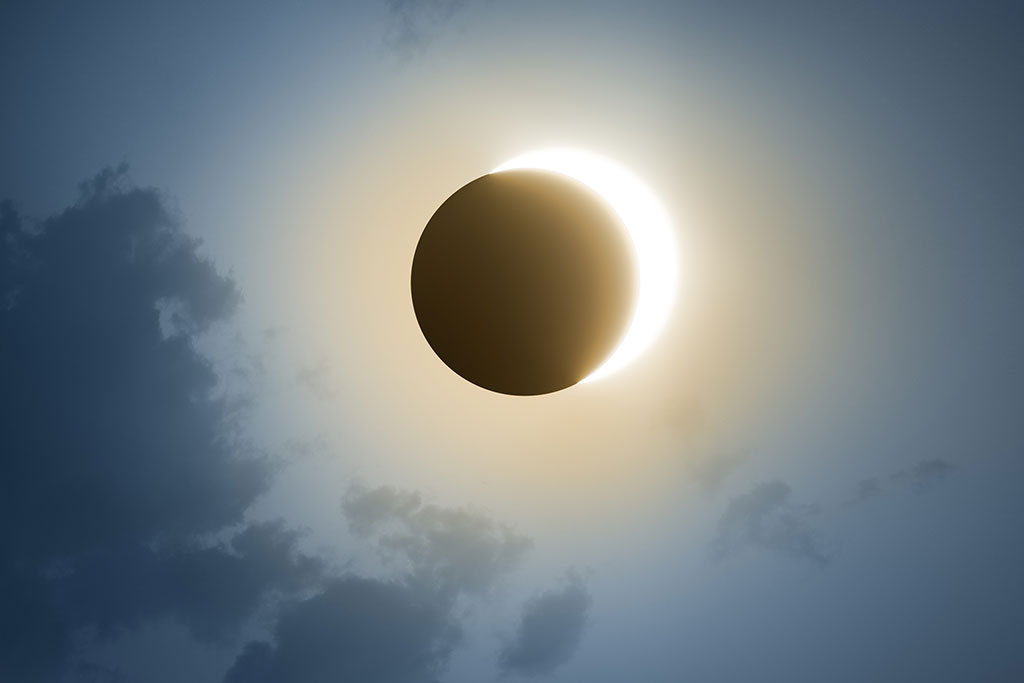
A total solar eclipse, like the one gracing certain skies this month, happens when the moon entirely obscures the sun. This captivating process unveils the sun’s elusive solar corona, its outermost layer. On average, any particular location on earth observes a total solar eclipse only about once every 360 years. For those within the path of totality, which is a narrow strip of the eclipse’s main path across the earth’s surface, the sky transforms into an inky darkness resembling nighttime for a brief moment. Just before and after totality, viewers can also witness the enchanting occurrence known as Baily’s Beads, where sunlight peeks through lunar valleys to form a string of radiant spots around the moon’s edge. As that effect fades, it transforms into the diamond-ring effect, in which a burst of light akin to a diamond ring shines bright.
Fortunately, the predictability of eclipses enables astronomers to use mathematical models to forecast their exact paths far in advance. For April’s total eclipse, only thirteen US states will be within the path of totality, but those who live outside it can still experience a partial eclipse, where the moon conceals most but not all of the sun. (Check out NASA’s guide to learn more about the eclipse’s path.) No matter the location, though, it’s an exciting opportunity for enthusiasts and novices alike to view the entrancing display.

Eclipse viewing tips
To ensure you have the most memorable viewing experience during the solar eclipse, prepare using these essential considerations.
Plan ahead
If you live in or are traveling to a city within the path of totality to witness the eclipse, make your plans well in advance. You can expect possible delays getting to your viewing location due to increased traffic and crowds.
Check the timing
Familiarize yourself with the eclipse’s schedule in your specific area. The total eclipse may only last for one to two minutes, so make sure to get to your chosen viewing spot early. Luckily, you will have more leeway with a partial eclipse, which typically lasts between seventy to eighty minutes.
Wear eye protection
Protect your eyes at all times when viewing any type of solar eclipse since gazing at the sun without proper protection can lead to irreversible damage. Utilize certified eclipse glasses that adhere to ISO safety standards, or construct your own eclipse projector following NASA’s recommended guidelines.
Consider weather contingencies
While the eclipse will occur no matter what, the weather may obstruct your view. Stay prepared for potential weather-related challenges, and have a backup plan, such as traveling to a different city or state, in case you need to make adjustments.
Embrace the moment
A total solar eclipse is a rare and extraordinary occurrence that you might only get to witness a few times in your life, so take a moment to savor the experience. Remember to relax, look around, and immerse yourself in the wonder of the event as it unfolds.
3319 Views
541 N. O St.
Livermore CA, 94551
